
KEY POINTS
- Global uranium resources exceed 8.1 million tonnes.
- Uranium demand could reach 143,900 tonnes a year under high growth.
- New uranium projects can take 15 to 20 years to develop.
Global uranium resources are sufficient to support the expected growth in nuclear power generation, but the International Atomic Energy Agency, IAEA, says new mines and projects must be developed much sooner to prevent future supply shortages.
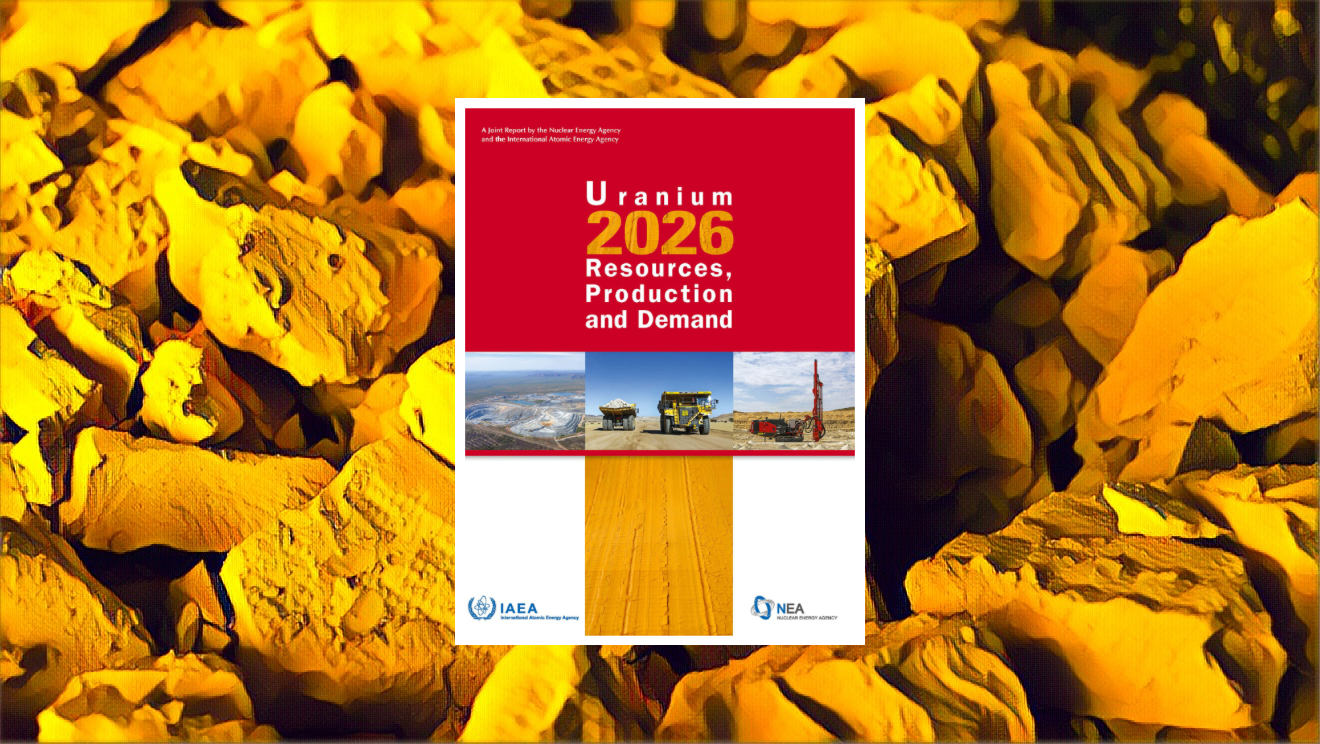
The warning is contained in the latest edition of “Uranium 2026: Resources, Production and Demand,” a joint report by the IAEA and the Nuclear Energy Agency (NEA) of the Organisation for Economic Cooperation and Development.
The report shows that uranium production is already increasing as countries look to expand nuclear power to strengthen energy security and reduce carbon emissions.
As of January 1, 2025, 418 commercial nuclear reactors were operating worldwide, with combined generating capacity of 378 GW(e). These reactors required about 64,500 tonnes of uranium a year to produce fuel.
Another 23 reactors, with a combined capacity of 19.7 GW(e), were in suspended operation at the time.
The IAEA and NEA expect global nuclear power generation to increase significantly in the coming years, even under lower-growth scenarios.
That expansion could push annual uranium requirements to between 84,800 tonnes under a low-growth scenario and 143,900 tonnes under a high-growth scenario.
The increase is being driven by efforts to improve energy security, meet rising electricity demand and support climate goals, with nuclear power expected to remain an important source of low-carbon electricity.
Uranium resources are not the immediate problem
The report estimates that the world has more than 8.1 million tonnes of identified uranium resources that can be recovered at costs below $260 per kilogram of uranium.
That figure represents a 2.1% increase from the previous 2025 edition of the report.
According to the agencies, the identified resource base is large enough to meet even the highest projected level of future uranium demand. The bigger challenge is turning those resources into actual production.
Developing a uranium mine requires extensive exploration, permitting, financing, construction and infrastructure development. The report estimates that bringing new uranium projects from initial identification through development can typically take 15 to 20 years.
That lengthy timeline means investment decisions made today will have a major effect on the availability of uranium decades from now.
The IAEA says sustained uranium prices and long-term supply contracts will be critical to encourage companies to invest in new projects.
Stable market conditions would give mining companies greater confidence to approve new mines, maintain exploration programs and invest in technologies that can improve uranium extraction and processing.
The report also stresses the need to accelerate innovation in extraction techniques so that existing resources can be recovered more efficiently.
Although uranium production and exploration investment have increased, much of the recent spending has gone into exploration rather than the development of projects capable of entering production.
That imbalance could create pressure on future supply if exploration discoveries are not converted into operating mines quickly enough.
The uranium industry has already responded to stronger demand expectations.
Global uranium production reached about 116,000 tonnes across 2023 and 2024, around 20% higher than production recorded in 2021 and 2022.
Production in 2024 alone stood at 61,924 tonnes, making it the highest annual output recorded since 2016.
The increase shows that producers are responding to stronger market signals, but the IAEA and NEA indicate that continued growth will require a much stronger project pipeline.
Investment in global uranium exploration and development also increased substantially.
Spending during 2023 and 2024 exceeded $1.78 billion, about 46% higher than the level recorded in 2021 and 2022.
However, the report noted that a significant share of the additional investment was directed toward exploration rather than project development.
This means the industry still faces the challenge of moving discoveries through feasibility studies, permitting, financing and construction before they can contribute to global uranium supply.
With nuclear power expected to expand, the report suggests that governments, utilities, miners and investors will need to plan further ahead to ensure adequate fuel supplies.
The availability of uranium resources may not be the main concern, but the speed at which those resources can be developed could determine whether supply keeps pace with the nuclear industry’s growth.