
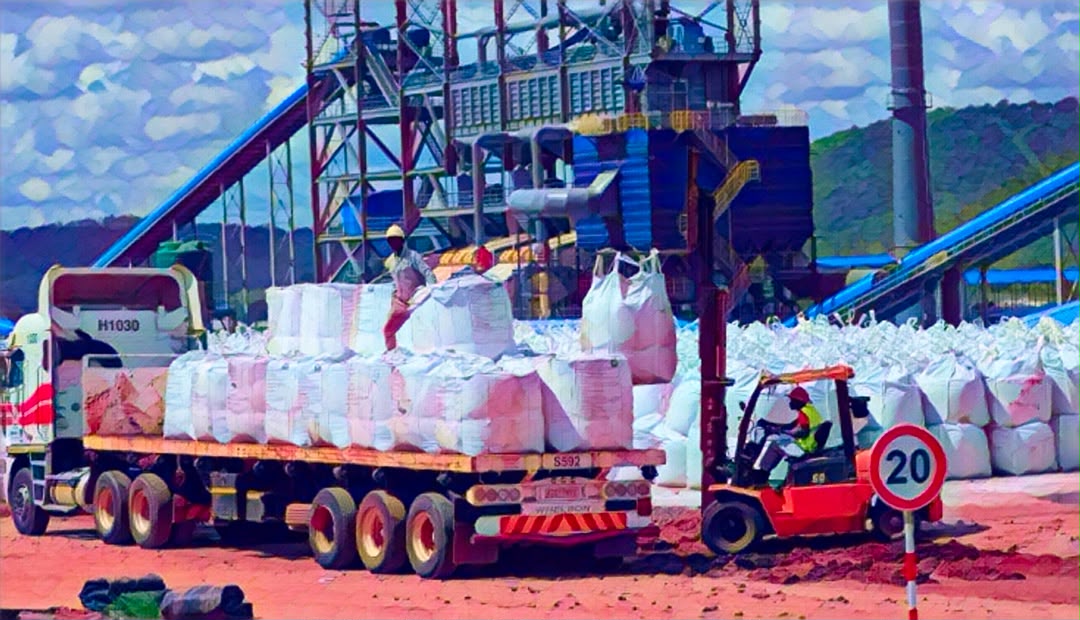
Zimbabwe lithium export earnings reached $2.16 billion in the nine months to Sept. 30, nearly four times the country’s total for all of last year, the state minerals marketing agency said Wednesday.
Minerals Marketing Corporation of Zimbabwe General Manager Nomusa Moyo told a briefing that the main driver was a 283% jump in the price of spodumene concentrate, a lithium bearing mineral and a key source of battery metal.
What is driving Zimbabwe lithium export earnings
Spodumene concentrate sales brought in about $1.8 billion, up 368% from the same period last year. Petalite, another lithium bearing mineral, added $155 million. Lithium sulphate, a processed chemical used to make battery grade compounds, contributed $190 million. Together, the three products account for the entire $2.16 billion.
Lithium products now rank as Zimbabwe’s biggest mineral export after gold. They overtook platinum group metals, which earned $1.73 billion over the same period. Lithium led by about $430 million and made up 45.6% of the agency’s mineral sales, which more than doubled to $4.74 billion.
Furnace maintenance at Zimplats also hurt platinum output and dispatches in September.
Processing starts to pay
Zimbabwe is also beginning to move beyond shipping raw concentrate. China’s Zhejiang Huayou Cobalt began exporting lithium sulphate in April from a $400 million plant, the first lithium salt facility in Africa. Moyo said the figures show the contribution that further processing is starting to make to export earnings.
Moyo credited the government’s push for beneficiation, along with producers’ investment and operating efforts, for lithium’s rise as the top earner. The state has pressed miners to build processing plants and has required written commitments with timelines.
Most Zimbabwean lithium goes to China. Chinese companies including Huayou, Sinomine, Sichuan Yahua, Chengxin Lithium and Tsingshan dominate mining and processing after investing about $2 billion since 2021.
A rush before the 2027 ban?
Part of the surge may reflect producers racing to export concentrate before Zimbabwe bans such shipments in January 2027, a rule meant to push more lithium into local processing. The government has already suspended raw mineral exports once this year and later eased the freeze with quotas.
The timing is striking. Earlier agency figures put lithium exports at $746 million for the first half, of which spodumene concentrate brought in $672.8 million and lithium sulphate $73.2 million. If both sets of numbers use the same basis, that implies roughly $1.4 billion in the third quarter alone. The agency credited first half gains mostly to stronger prices, since volumes rose only 2% in the first quarter.
What it means for Zimbabwe
The windfall comes with risks. Lithium prices swing hard, with carbonate falling from above $80,000 a ton in late 2022 to below $13,000 a year later. A market that rewards producers today can punish them quickly, and most of Zimbabwe’s lithium depends on Chinese buyers.
Higher prices and early processing have handed Zimbabwe a windfall. Turning it into lasting industry will depend on whether the new sulphate plants keep running and prices hold when the export ban arrives.