
KEY POINTS
- Passive systems control airflow so dust settles back onto the material.
- Better enclosures, curtains and skirting can improve workplace safety and reduce spillage.
- Retrofitting conveyors can lower cleaning, maintenance and downtime costs.
Passive dust control is emerging as a practical way for mines and other bulk-material handling industries to reduce airborne dust, improve workplace safety and lower maintenance costs around conveyor transfer points.
The approach focuses on improving enclosure design and controlling airflow so that dust remains within the transfer point and settles back onto the material instead of being released into the surrounding environment.
Conveyor transfer points are among the areas where dust and material spillage commonly occur. When bulk materials move from one conveyor to another, the impact and movement of the material can generate airborne particles, creating safety, health and air-quality concerns.
The problem is particularly important in industries handling materials that contain respirable crystalline silica (RCS). Prolonged exposure to respirable silica can contribute to serious occupational diseases, including silicosis, pneumoconiosis and chronic obstructive pulmonary disease.
However, dust-control measures are not limited to mining operations. Industries such as recycling, agriculture, ports and steel production can also benefit from effective systems that reduce airborne particles and improve working conditions.
Passive Dust Control Uses Airflow to Contain Dust
Unlike powered extraction systems that rely on air cleaners, dust collectors or HVAC-style hoods, passive dust control works primarily through engineering and enclosure design.
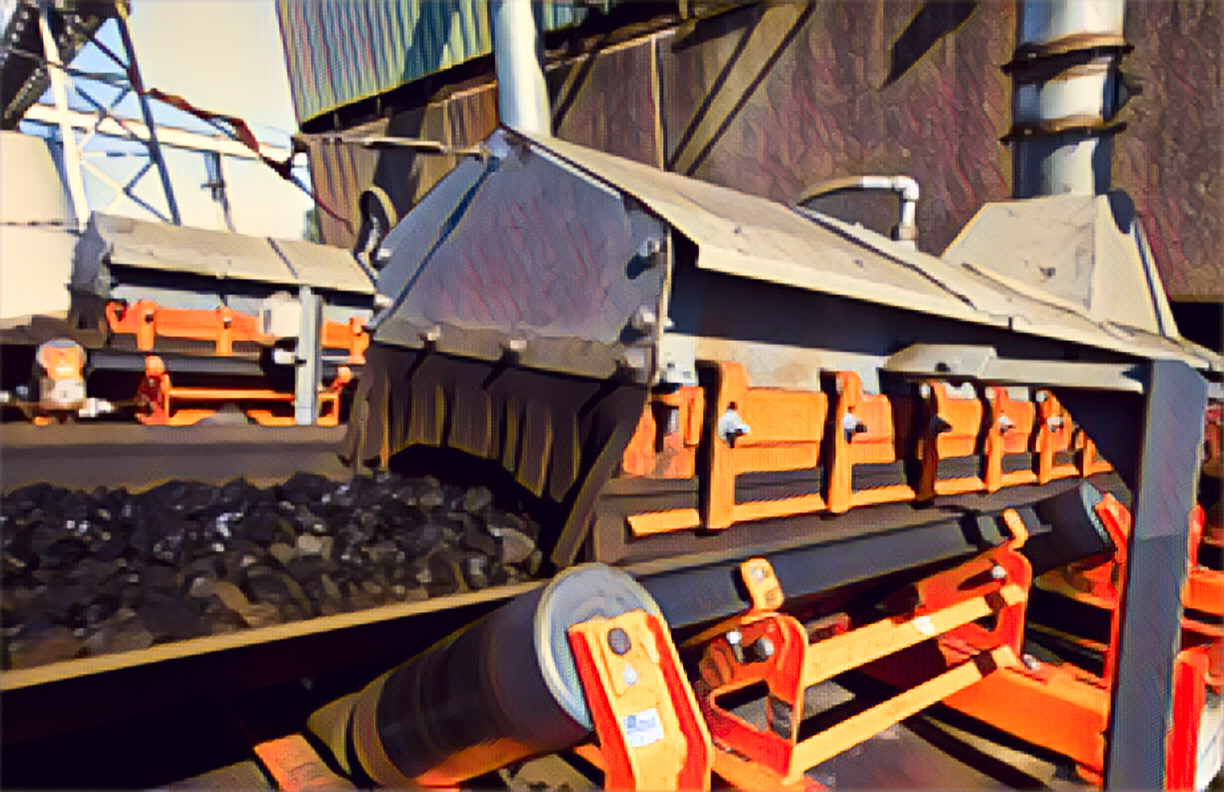
The conveyor transfer point is enclosed with skirtboards and curtains designed to control the movement of air inside the transfer area. The objective is to slow turbulent airflow sufficiently for dust particles to settle back onto the material stream.
This makes the skirtboard enclosure function much like a settling chamber. Larger particles settle relatively quickly, while smaller particles require greater control of airflow and more time within the enclosure.
The system therefore seeks to prevent dust from escaping rather than relying solely on equipment that removes dust after it has already become airborne.
The effectiveness of passive dust control depends heavily on controlling airflow through the conveyor enclosure.
According to the article, conveyor enclosures are generally designed around an air velocity of no more than 1.0 metre per second. Increasing the height of the enclosure can provide a longer path for particles to settle before they can escape.
Air velocity within skirtboards is influenced by the amount of induced airflow and the cross-sectional area of the enclosure. Typical average velocities can range from about 0.8 to 2.8 metres per second.
The highest air velocities are generally found beneath the skirtboard curtains, making the proper positioning and sealing of curtains particularly important.
The growing focus on occupational health and environmental compliance means that effective dust management remains an important priority for mining companies and bulk-material handlers.
A well-designed conveyor transfer point can reduce both airborne emissions and material spillage while limiting the amount of manual cleaning required around the equipment.
By combining controlled airflow, adequate enclosure dimensions, multiple curtains and effective skirting, operators can create a more controlled environment without necessarily relying on energy-intensive extraction systems.