
Key points
- Sandvik Rock Processing says miners and quarries increasingly want optimization across the full crushing and screening circuit rather than individual machines.
- The company showed its fully electric UJ443E tracked jaw crusher and upgraded CH442 cone crusher at Electra Mining Africa in Johannesburg.
- Distributor S&R Enterprises says Sandvik’s electric models cut overall costs by about 30% to 50%, with four new electric products planned this year.
Sandvik Rock Processing says African mining and quarrying customers now want partners who can optimize their entire crushing and screening circuits, not just supply better machines.
Tarynn Yatras, the company’s vice president of sales for Africa, said conversations throughout Electra Mining Africa, held in Johannesburg from Sept. 7 to 11, kept returning to the same theme. According to her, operators face pressure to lift productivity while cutting energy use, operating costs and environmental impact, and they have concluded that the biggest gains sit in how the whole system performs.
“Across both mining and quarrying, customers are looking beyond individual machines,” she said.
Historically, plants improved one asset at a time. Crushers ran for throughput, screens ran for separation, and downstream equipment ran on its own settings. However, Yatras said that approach ignored how tightly modern plants are linked. A change in crushing performance ripples through screening, classification, grinding and recovery, and ultimately through plant productivity.
Engineering around each orebody
Because of this, Sandvik leans on what it calls an engineering-to-order philosophy. Rather than selling standard packages, the company designs processing solutions around each customer’s ore characteristics, production targets and site constraints.
Yatras said this mattered more as mines tried to squeeze value from existing assets instead of building new plants. In addition, she stressed that equipment was only part of the answer. The work starts with understanding the application and objectives, she said, and the machines simply become the platform for that solution.
Comminution offers the clearest example. Grinding remains one of the largest energy consumers in mineral processing, so efficient crushing and consistent feed to the mills can cut energy demand while improving throughput and stability.
“Every millimeter of size reduction achieved efficiently during crushing reduces the amount of work required later in the process,” Yatras said.
Electric crushers gain ground
Meanwhile, digital monitoring and automation now let operators spot bottlenecks before they hit production, which supports steadier operating conditions across the circuit.
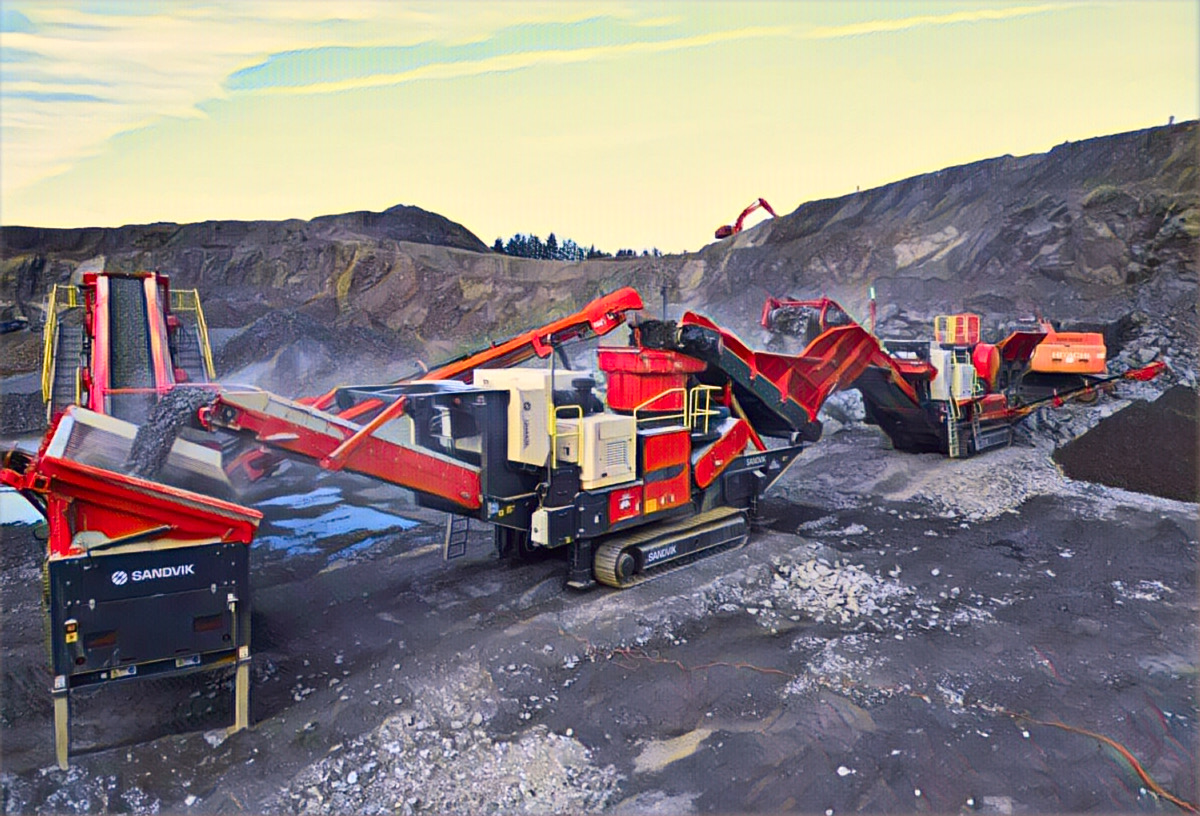
On the equipment side, Sandvik displayed its fully electric tracked jaw crusher, the UJ443E, alongside the upgraded CH442 cone crusher. Yatras said demand for electric jaw crushers had picked up across Africa as the sector moved toward net zero.
The UJ443E can run from an external power supply or from an onboard generator set using diesel or hydrotreated vegetable oil. Running on grid power lowers costs, stretches drivetrain service intervals, reduces refueling time and cuts on-site emissions and noise, according to the company.
Stephen Smith, managing director of distributor S&R Enterprises, said Sandvik’s electric models save customers about 30% to 50% on overall costs. Furthermore, he said the company plans to launch four new electric products this year.
Ultimately, Yatras said, performance is no longer about what one crusher or screen can do. “It is measured by how efficiently the entire process works together,” she said.